
The Cutting Room Floor
Not Everything You Wrote That You Love Survives

As I mentioned in the last update, while writing Feed the People!, I had to learn to recognize “defensive writing” tics that are common in academic humanities writing and pare them from my prose. In addition, I’ve also had to learn to be more attentive to criticisms that are less conceptual and analytic and more narrative and stylistic. I’m fond of asides and digressions—you probably already know this about me; I’m doing it right now!—and I do love a good joke. My editors know that’s part of what makes my voice distinctive, but that too much of it can be distracting, irritating, and may even undercut my authority to write about what, after all the yucks, are very serious issues. This usually plays out with my early drafts having more jokes and “fun” examples that get ironed out in subsequent drafts. If I can actually make an editor laugh out loud, I may even be allowed to keep a few of my babies, but most of them, alas, die on the cutting room floor.
The cutting room floor, as a result, often makes for an interesting archive. It’s a place where you can locate ideas that were appealing but that, for whatever reason, didn’t fit. Analyzing why they don’t fit, in turn, can clarify what it is you’re actually arguing. We often assume that the work of writing is, first, to think a good thought that ought to be expressed and, second, to clearly express that thought on the page. In fact, for me, the experience of writing is something different: I have a thought that is promising but perhaps muddy, and as I work to put it on the page, that original thought comes into sharper definition in my mind. I don’t so much express a thought I had as think through my proposition as I write. And this process—with all its twists, turns, half-starts, and stutters—is exactly what I encounter in what I can sweep up from the cutting room floor.
To give you an illustration, I thought it would be fun to compare the original opening vignette of “Chapter 1: The Case for Democratic Hedonism” with the vignette that we wound up using in the book. I much prefer what we ultimately used for our book, but I also happen to love the vignette we wound up cutting, albeit I love it for something else. Our judgment was that, even though it was a fun and intriguing bit of writing, it didn’t fit with the tone and emphasis of the chapter itself, especially as almost everything else in the book is set in the United States.

[Berghain, home of excellent ice cream and potato salad and, oh, some other pleasures.]
In any case, I’ll present the cutting room vignette below and then the vignette we used below it.
The Berlin nightclub Berghain is world-famous for its devotion to unfettered, libertine pleasure or, you know, degenerate hedonism. Every weekend, hundreds of people form lengthy queues outside a gargantuan former thermal plant just a few blocks from the East Side Gallery, where the remnants of the Berlin Wall track the shore of the Spree. They queue, often for three or four hours at a time, for just a shot at entry. Rejection, usually proffered with little more than a handwave, head shake, or “heute nicht” from the club’s bouncers, can hover at a rate of 80 to 90%, and the club’s too-cool-for-school public image is distinctively tied to its exclusivity. Allegedly, Elon Musk was bounced twice in the same day.
What exquisite delights could possibly justify such lines? It’s a heady mix of sex, drugs, and techno. The lucky few who make it past the door will often spend marathon sessions in the club, dancing under the vaulted concrete ceilings of the reclaimed industrial space for hours and even days on end. Ecstatic revelry of such duration creates moments of pure magic you must experience to understand: around dawn, the shutters are drawn up in Panorama Bar, the dance floor on the highest level of the club, and the party is suddenly consumed by a light that is equal parts the fires of heaven and hell, an exquisite apocalypse. The club’s regulars call Berghain “church” for a reason.
But for all this pleasure and exertion, the consummate source of daily delight and energy, food, is mostly absent in Berghain. You can bring in simple, prepackaged foods such as protein bars or pretzels, and you can buy a Mounds bar at the coat check near the entrance. Sometimes an older gentleman wanders around the lower level of the club selling simple sandwiches from a basket. But most people either do without food or leave the club to gobble a currywurst or döner kebab from a nearby restaurant. (Reentry to the club that bypasses the bouncers’ judgment is allowed for a small fee, but the reentry queue can sometimes be as long as the main queue.)
But here’s a secret: buried deep within Berghain, off the vast dance floor on the second level, tucked into the far corner of a long chamber that houses a busy bar, is a steep metal staircase. Up those stairs is Eisbar, a tiny retreat in the club’s otherwise cavernous spaces, containing just a counter and a few low-slung couches. If they are even aware of its existence, Eisbar may confuse those who associate Berghain with avant-garde coolness. In a space of such carefully curated exclusivity and aestheticized hedonism, Eisbar mostly sells a basic normie pleasure: ice cream.
You cannot fill your belly entirely at Eisbar. It sells treats, not meals. But when you’re dragging and your blood sugar is low, even a few bites of very good ice cream may be just what you need to rejoin the glorious mess of humanity below. In the midst of a world-class rave, some blessed soul decided that it is simply nice to have an ice cream. And they were right.
The ice cream at a Berlin techno club offers some important object lessons about pleasure. Even in a world of exclusive and rarified pleasures, common gustatory pleasures pack a punch. People want an icy nibble of lustrous creaminess. They’re not deterred by—in fact, they probably don’t give a second thought to—the fact that it is a product of conventional, large-scale processes and modern industrial technology. To understand why people crave particular food pleasures, you need to account for both the personal and the social, the sensual and the transcendent, the flavor of the ice cream and the ecstasy of the rave. Sometimes how food pleasure is packaged, wrapped as it may be in the severe industrial facade of a thermal plant—or in the plastic wrapper of a mass-produced snack—belies what is good, gentle, and nurturing, and, by contrast, sometimes a pastoral appearance can hide a less appealing reality of extraction and exploitation.
I should note now that it’s good that we didn’t use this vignette because—and I can confirm this from my most recent visits—Eisbar now also sells potato salad and some other savory dishes. It’s all excellent, and it wouldn’t surprise me if they gave quite a bit of thought and attention to the quality of ingredients and where they’re sourced from. (It also wouldn’t surprise me if they buy a huge bag of conventional potatoes from Penny.) I tried to interview the people who manage Eisbar, but I was… DENIED (the interview, not entry to the club.)
Let’s now compare that piece to what we used in the book:
A good food system should be based on food that tastes good, is available to as many people as possible, and causes as little harm as possible.
This simple fact was made abundantly clear to us one chilly March morning in Brooklyn, when we feasted on breakfast sandwiches from ATM, Jan’s favored deli near where he teaches at Pratt. The night before, we had scored a reservation at Eleven Madison Park, a legendary fine-dining restaurant in Manhattan awarded three Michelin stars that had gone plant-based in 2021, leading to much international debate, publicity, and acclaim. The multicourse meal had its high points to be sure—a crisp and salty sweet potato tart and the between-course mugs of rich umami roasted rice broth stuck with us—and the restaurant’s veggies-only menu tugged at our political and environmental affections. We wanted to love our experience. What could be better for two professors who write about the many harms the food system does, including to animals, than dining at perhaps the world’s most celebrated vegan restaurant? The menu was thoughtful, meticulously curated, Instagram-ready, duly expensive, and, in its own way, environmentally and politically righteous.
What it wasn’t was particularly pleasurable. The dishes were cerebral odes to technique and restraint that, sadly, just didn’t deliver. One memorably catastrophic dish featured a piece of steamed Chinese broccoli entwined in a lonely, wan noodle. These listlessly rested in a puddle of a murky soy sauce concoction that someone had dusted with shaved truffles. The one promising item on the plate—the noodle—was so miserly in its portioning that it felt downright hostile. The whole dish was completely overwhelmed by the truffles, which tasted more like an idea of luxury than luxury itself. Most of the meal wasn’t that bad, but the dish did illustrate the limits of foodie aesthetics and ideals in stark terms: theoretically noble and high-minded ideas that work best on paper above practically sensual delights that work on the plate, asceticism masquerading as minimalism, and appeal rooted in expense and elitism. Rarified pleasures that, for the most part, aren’t all that pleasurable. The service, we should note, was indeed world-class.
But the next morning, Jan’s stomach roiling from one too many too-fancy cocktails, Gabriel’s eyes still bleary from sleep, a single bite of ATM’s plant-based breakfast sandwich, a greasy delight modeled on the standard-issue New York City deli bacon, egg, and cheese sandwich, and the meal from the night before was a distant memory. This is what we’d wanted all along. Simple, savory, familiar, filling, affordable, and, in its own right, environmentally and politically righteous.
Among other things, you’ll notice what we used was much shorter and more firmly anchored in American food culture. Meanwhile, the description of the disappointing meal at Eleven Madison Park is one of the places where the sensual aspects of eating are most present in the entire book—we are actually describing the taste of something we ate—while, in the first vignette, it is the fact of ice cream, not the taste of the ice cream itself, that takes center stage. The subtle difference is crucial in a chapter that argues we must take the phenomenological experience of food pleasure seriously to build an effective food politics.
The Regenerative Shimmy
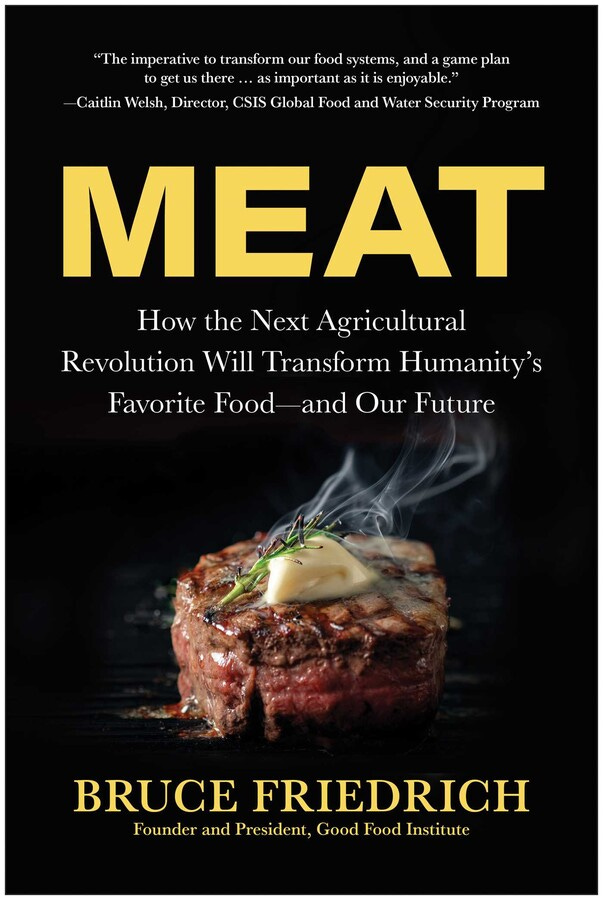
[Bruce Friedrich’s great book is also out and highly recommended. I expect it will be reviewed alongside ours in many outlets.]
While I have you, I thought I’d share some responses to the book and the public writing we’ve been doing in support of it. The first review is in! The Financial Times did a joint review of the book with Bruce Friedrich’s also excellent Meat: How the Next Agricultural Revolution Will Transform Humanity’s Favorite Food — and Our Future. It’s a generally positive review for both books and concludes with this line: “Both books bring a passion to the affluent society’s intractable modern dilemma of what to eat. As Rosenberg and Dutkiewicz say, it is a dilemma probably most effectively addressed without preaching.”
Meanwhile, we’ve been getting plenty of heat for our New York Times op-ed that offered a condensed version of the qualified defense of industrial foods we offer in the book. We didn’t get into it in the op-ed, but in the book we note that a huge portion of “farms” in the United States are primarily speculative real estate ventures: the owners of the land hold it because it is an appreciating asset; few directly farm it for a profit; some rent the land to other people to be commercially farmed; some live on it as well because they enjoy the serenity of rural living as an amenity and are willing to pay a premium for it. 40% of all American farms are what the USDA classifies as “off occupation” farms, farms where the operator derives most of their income from off-farm employment. This group has an average household income of $160,000 per year and holds an average wealth of about $1.8 million. On average, they report net losses of nearly $5,000 from whatever limited farming activities in which they engage. We note that this group of farmers (we cheekily call them the “gentry”) makes life more difficult for other farmers hoping to sell food in nearby cities. They’re competing for the same land, and the Gentry love land that is proximate to cities, most of all because that’s often where their jobs are (and plus then they can enjoy the best of both town and country). But this sort of “lifestyle” or hobby farming drives up demand for farmland that, in turn, increases the operational costs of farmers hoping to actually turn a profit from growing food and selling it to consumers.
This conclusion is part of the broader analysis in the book that most people who own farmland in the United States are wealthy and that you need to start from that fact if you want to understand why farmers support the particular policies they support. A jokey line we didn’t include in the book (another victim of the cutting room floor!) is that seen from that perspective, some group of farmers favor regenerative and agroecological methods that are more land intensive because it will pump the value of the land that they already own: they are, in essence, rural NIMBYs trying to guard their property interests but masking it behind high-minded environmentalist sloganeering.
Without knowing much about the economic background of a particular farmer, it’s always hard to assess when this is in play. The regenerative/agro-ecological space also has many principled and earnest people who are not large landowners and are doing their best to translate high-quality ecological research into practically adaptable cropping techniques. (Notably, however, in the UK many of these types, even the earnest ones, appear to be funded, at least in part, by the nation’s largest landowner, who also happens to be their hereditary monarch; ah, but I digress.) In conversation, I usually resist saying, “Sure, but using more land-intensive cropping techniques would also protect the value of that multimillion-dollar asset that you own, which is, I’m sure, just a complete coincidence.” It probably wouldn't convince them, and it might be unfair, which I want to avoid.
With that said, I literally laughed out loud at this response from someone promoting “a new agrarian movement” and defending local and regenerative farming from Jan’s and my scurrilous attacks. No, no, not because of the substance of the post, which is mostly marketing and sloganeering; it repeats talking points without citation that are, upon close examination, specious or tendentious, and that we explicitly rebut in the book.
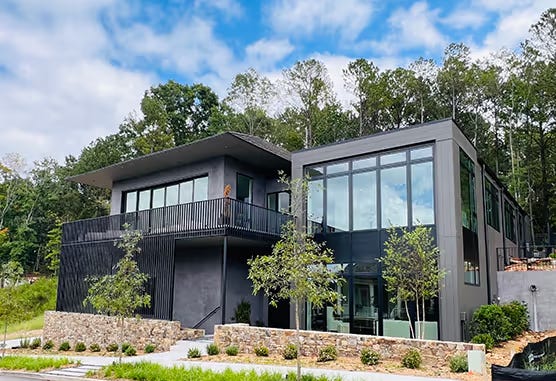
[For a cool $2.8 million you can join this “new agrarian movement” and live in this house.]
What made me laugh was that this person is also literally a real estate developer attempting to sell multi-million dollar homes in a “biophillic community” outside of Atlanta. You wouldn’t know it from the piece, but click through to the bio! In the piece itself, he sets himself as the noble defender of American farmers who’ve been hard done by the market: “Across the U.S., farmers face rising input costs, volatile markets, mounting debt, and increasing climate risks.” You’ll know from our book that farm foreclosures are exceptionally rare—there were only 312 in 2025 out of around 2 million farms—but, that aside, I’m curious as to how many struggling small farmers will be able to afford this $2.8 million “cottage” he’s advertising. Or, for that matter, the least expensive option in his real estate development, this 892-square-foot condo that costs only a cool half million. It’s harder to come up with an easier illustration of just how much of what’s being advertised as “regenerative” agriculture—a term with no agreed-upon or legally binding definition—is agrarian cosplay for rich people.
Rarely a week passes when an advocate of nebulously defined “regenerative agriculture” doesn’t pop up to explain that regenerative agriculture is about farming in ways that account for more than just profit extraction. I will start to take this seriously when they also start to also argue for binding legal definitions of “regenerative agriculture” and can produce peer-reviewed evidence that shows that farms that operate according to those definitions are both solvent and have reduced net environmental impacts (including accounting for opportunity costs in terms of biodiversity, carbon sequestration, and water-quality loss compared to unmanaged wilderness.) They are unlikely to ever do either of these things, because, just as with hostility to organic standards and efforts to police just how “local” putatively local food is, many farmers, even the kindly ones, don’t like the idea of answering to Washington D.C. or, for that matter, being held accountable to binding production standards. They don’t like doing this because it’s not in their interests, a fact the high-minded marketing and sloganeering tend to obfuscate. But until they do that, they offer no way to distinguish between what may be practical and beneficial cropping techniques and what are marketing gimmicks intended just to sell consumers on the latest thing.